


Back

Share

TPE vs. TPR: A Complete Material Guide



- ChatGPT
- Perplexity
- Google AI
- 2026-03-23
Thermoplastic elastomers (TPEs) have transformed the rubber and plastics processing industry. By eliminating the need for vulcanization — a time- and energy-intensive step in traditional rubber manufacturing — TPEs can be processed on standard thermoplastic equipment, including injection molding, extrusion, and blow molding machines, delivering significant cycle time and cost advantages.
Yet one question comes up repeatedly among design engineers and procurement teams: What is the difference between TPE and TPR? While the two terms are often used interchangeably, they refer to distinct material types with different chemical bases, performance profiles, and application fits. This guide breaks down the key differences and provides a comprehensive framework for making the right material selection.
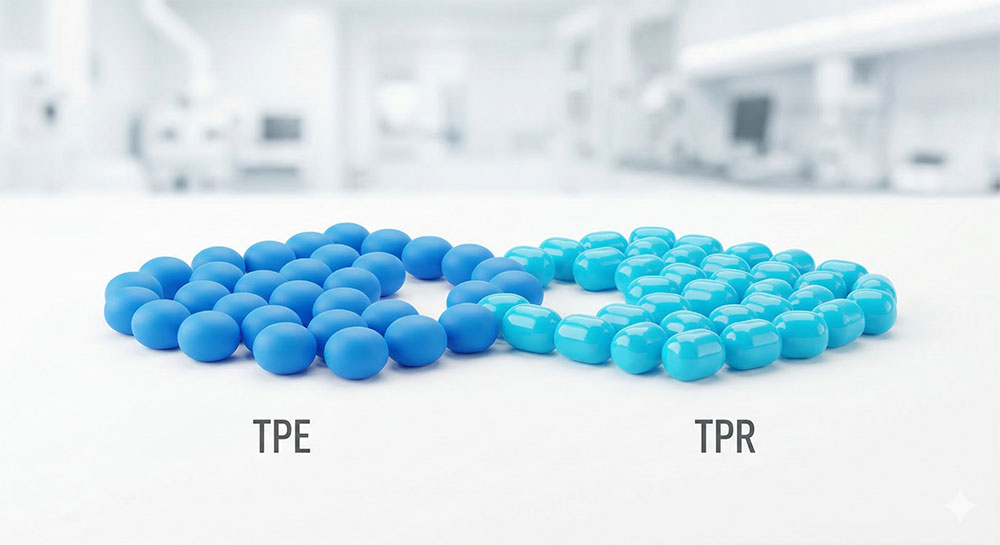
What Are Thermoplastic Elastomers? TPE vs. TPR — Chemical Basis
Thermoplastic elastomers combine the elastic performance of rubber with the processing convenience of thermoplastics. While both TPE and TPR fall under this broad classification, the industry typically differentiates them by their polymer backbone:
TPE (Thermoplastic Elastomer)
In a narrower technical sense, TPE typically refers to compounds formulated on a SEBS (Styrene-Ethylene-Butylene-Styrene) backbone — a hydrogenated styrenic block copolymer.
-
Key Characteristics
: Hydrogenation saturates the polymer backbone, resulting in excellent UV stability, weathering resistance, and thermal stability.
-
Appearance & Feel
: SEBS-based TPE typically exhibits a matte, low-gloss surface with a dry, smooth, skin-friendly tactile quality.
TPR (Thermoplastic Rubber)
TPR is typically based on SBS (Styrene-Butadiene-Styrene), a non-hydrogenated styrenic block copolymer.
-
Key Characteristics
: The unsaturated backbone makes TPR behave more like conventional rubber, offering high tack and grip — but with lower weathering resistance and reduced aging stability compared to TPE.
-
Appearance & Feel
: TPR surfaces are glossy and reflective, with a tacky or high-friction texture.
TPE vs. TPR: Key Property Comparison
The table below provides a side-by-side comparison of the most decision-relevant properties for material selection:
| Property | TPE (SEBS-Based) | TPR (SBS-Based) |
|---|---|---|
| Visual Appearance | Matte finish, low gloss | High gloss, reflective surface |
| Surface Feel | Smooth, dry, silky to the touch | Tacky, high friction, gripping texture |
| UV & Weather Resistance | Excellent — suitable for long-term outdoor use | Poor — yellowing and cracking under prolonged UV exposure |
| Adhesive Compatibility | Low affinity with adhesives | Bonds readily with adhesives — ideal for post-assembly bonding |
| Burn Characteristics | Low smoke, faint aromatic odor | Dense black smoke, sharp, pungent odor |
| Typical Applications | Medical devices, food-contact components, premium tool grips | Shoe soles, casters, general toys, automotive floor mats |
TPE vs. TPR vs. TPU: At-a-Glance Comparison
Engineers frequently ask where TPU fits relative to TPE and TPR. The table below positions all three materials across the key selection dimensions:
| Material | Chemical Base | Best-Fit Applications | Key Strengths |
|---|---|---|---|
| TPE | SEBS (hydrogenated styrenic block copolymer) | Soft-touch consumer products, medical devices, food-contact parts | Superior weatherability, regulatory compliance, matte tactile finish |
| TPR | SBS (styrenic block copolymer) | Shoe soles, anti-slip mats, indoor consumer goods, adhesive-bonded assemblies | High coefficient of friction, cost-effective, excellent adhesive bonding |
| TPU | Polyurethane | High-wear industrial components, athletic equipment, medical tubing, drive belts | Outstanding abrasion resistance, broad service temperature (-40°F to 248°F / -40°C to 120°C+), high tear strength |
For most applications, the selection logic is straightforward: specify TPE for soft-touch performance and regulatory compliance; TPR for high friction and cost efficiency; TPU for maximum abrasion resistance and broad service temperature range.
Read more: Applications of Thermoplastic Elastomer (TPE)
TPE vs. TPR: Application Breakdown by Industry
Although TPE and TPR share a similar look and feel at first glance, differences in weatherability, adhesive compatibility, and regulatory certifications drive distinct application profiles across industries:
| Industry | TPE Applications | TPR Applications |
|---|---|---|
Medical & Pharmaceutical |
IV bottle caps, medical tubing, surgical instrument grips, respirator masks ☞ Read More: Medical Tubing and IV Sets Utilizing TPE Compounds |
Non-contact medical packaging components |
Consumer Electronics |
Earphone tips, phone cases, wearable straps, button gaskets | Remote control keypads, low-cost cable jackets |
Automotive |
Steering wheel overmolds, door seals, under-hood sealing components ☞ Read More: Optimizing Automotive Back Door Cushion Seals for Enhanced Performance — Discover how GP-80BE(1) balances softness and durability to reduce noise and vibration in vehicle interiors. |
Floor mats, carpet backing, casters |
Sports & Outdoor |
Bicycle grips, diving mask skirts, protective padding | Athletic shoe outsoles, sports equipment outer shells |
Industrial Tools |
Power tool grips, wrench overmolds, industrial pipe seals [2] ☞ Read More: Optimizing Power Tool Applications with High-Performance TPE Solutions |
Hand tool handles, low-cost fittings |
Food & Packaging |
FDA-compliant gaskets, baby bottle nipples, cookware handles [3] Read More: Exploring the Advantages and Applications of Easy Peel film from TPE Compounds in Medical Device Packaging |
General-purpose container lid seals (non-direct-contact) |
Building & Construction |
Window frame seals, pipe waterproofing sleeves | Anti-slip floor mats, low-cost weatherstripping |
Material Selection Principles
-
Specify TPE when
: the end product requires long-term outdoor durability, direct human contact (medical or food-grade), or compliance with FDA, USP Class VI, RoHS, or REACH regulations. TPE's stability and certification track record make it the non-negotiable choice.
-
Specify TPR when
: the application is primarily indoor, demands high surface friction (e.g., footwear outsoles), or the downstream process involves adhesive bonding. TPR's property profile and cost structure offer a clear advantage in these scenarios.
-
EVERLON's portfolio coverage
: EVERLON's EVERMedi (medical-grade), EVERSeal (food-contact-grade), and industrial compound lines are engineered to address the full spectrum of application requirements listed above.
Material Performance Deep Dive
Beyond application fit, a rigorous material selection process requires evaluating the underlying physical and mechanical properties. The table below rates TPE and TPR across ten performance dimensions using a five-star scale (★ = higher is better):
| Performance Property | TPE (SEBS) | TPR (SBS) | Notes |
|---|---|---|---|
Tensile Strength |
★★★★☆ | ★★★☆☆ | TPE's saturated backbone delivers more consistent tensile performance |
Tear Resistance |
★★★★☆ | ★★★☆☆ | TPE is less prone to propagating tears under localized stress |
Elastic Recovery |
★★★★★ | ★★★★☆ | TPE recovers faster with lower residual deformation |
Compression Set |
★★★★☆ | ★★★☆☆ | Lower value = better. TPE retains sealing performance under sustained load |
UV & Weathering Resistance |
★★★★★ | ★★☆☆☆ | Hydrogenation gives TPE a major advantage over TPR outdoors |
Chemical Resistance |
★★★★☆ | ★★★☆☆ | TPE shows higher tolerance to acids, bases, and cleaning agents |
Abrasion Resistance |
★★★☆☆ | ★★★★☆ | TPR's higher friction coefficient translates to better wear resistance |
Low-Temperature Flexibility |
★★★★★ | ★★★☆☆ | TPE remains flexible at –40°F (–40°C) |
Melt Flow / Processability |
★★★★☆ | ★★★★★ | TPR's lower viscosity offers slightly easier injection flow |
Cost Efficiency |
★★★☆☆ | ★★★★★ | TPR carries a lower raw material cost in most formulations |
How to Read the Data
-
Weathering & service life
: TPE leads decisively in UV resistance, outdoor weatherability, and low-temperature flexibility — making it the preferred choice for outdoor products and long-term sealing applications.
-
Grip & friction
: TPR's higher abrasion resistance and superior melt flow give it an edge in high-friction applications such as shoe outsoles and anti-slip pads.
-
Total cost of ownership
: While TPR carries a lower raw material cost, TPE's long-term dimensional stability often reduces scrap rates, warranty claims, and replacement costs — yielding a more favorable TCO in demanding applications.
-
Compression set & sealing performance
: TPE's superior compression set recovery is critical for gaskets, O-rings, and medical closures. EVERLON's TM-45GWX achieves a 26% compression set (ASTM D395) — a benchmark performance level for medical IV cap applications.
Advanced TPE Family Members: TPU, TPO, TPV, COPE & COPA
Beyond standard SEBS and SBS formulations, the TPE family includes a range of high-performance engineering elastomers engineered for extreme service environments:
-
TPU (Thermoplastic Polyurethane): The highest tensile strength, abrasion resistance, and tear strength in the TPE family. Widely used in inline skate wheels, medical tubing, athletic equipment, and automotive suspension bushings. Note: TPU has higher processing sensitivity and a rougher tactile feel than SEBS-based TPE.
-
TPV (Thermoplastic Vulcanizate): A dynamically vulcanized blend of polypropylene (PP) and EPDM rubber. TPV delivers superior heat resistance (up to 240°F / 115°C continuous service), oil resistance, and compression set performance — the go-to material for under-hood automotive seals, hoses, and gaskets.
Read More: Enhancing Syringe Plunger Seal Integrity with EVERMedi TPV — See how TPV's low compression set revolutionizes medical sealing performance -
TPO (Thermoplastic Polyolefin): A blend of PP and non-crosslinked rubber offering outstanding impact toughness and UV stability. Extensively used in automotive exterior fascias, bumpers, and exterior architectural profiles.
-
COPE & COPA (Copolyester & Polyamide Elastomers): Premium-grade elastomers capable of sustained high-temperature service and high-cycle flex fatigue. Typical applications include automotive CV joint boots, industrial cable jacketing, and high-frequency dynamic sealing components.
Thermal Performance Comparison: TPU, TPO & TPV
Thermal resistance is often the deciding factor in industrial material selection. The table below summarizes the service temperature limits, primary advantages, and representative applications for each material:
| Material | Max. Continuous Service Temp. | Key Advantage | Representative Industrial Uses |
|---|---|---|---|
| TPV |
240°F (115°C) Some grades rated to 248°F (120°C) |
Best-in-class heat resistance, oil resistance, and compression set performance | Under-hood seals, industrial hose, gaskets, weatherstripping |
| TPO | 230°F (110°C) | Outstanding UV stability and outdoor weatherability | Automotive bumper fascias, exterior architectural profiles, outdoor components |
| TPU |
–40°F to 248°F+ (–40°C to 120°C+, grade-dependent) Standard grades: ~200°F (93°C) |
Best abrasion resistance; widest service temperature range | Drive belts, casters, suspension bushings, high-pressure hose |
-
Sustained high-temperature and high-pressure service (e.g., engine compartment seals): Specify TPV.
-
Outdoor UV exposure with moderate thermal demands (e.g., exterior architectural trim): Specify TPO.
-
Dynamic abrasion with wide temperature swings, below continuous boiling point (e.g., drive belts, wear-resistant tubing): Specify the appropriate TPU grade.
Processing Methods for TPE and TPR
One of the most significant advantages of TPE and TPR over conventional vulcanized rubber is their compatibility with standard thermoplastic processing equipment — no cure ovens, no sulfur-based cure systems. The table below covers the five primary processing methods, including compatible materials, temperature windows, and critical process parameters:
| Process | Compatible Materials | Barrel Temp. | Mold Temp. | Key Considerations |
|---|---|---|---|---|
| Injection Molding | TPE / TPR / TPU / TPV |
320–430°F (160–220°C) |
68–104°F (20–40°C) |
Verify shrinkage allowance; hot-runner systems recommended to minimize scrap |
| Extrusion | TPE / TPR / TPV |
300–390°F (150–200°C) |
Water-cooled sizing tank | Control haul-off speed and cooling rate to maintain consistent cross-section |
| Blow Molding | TPE / TPR |
340–410°F (170–210°C) |
50–77°F (10–25°C) |
Wall thickness uniformity is critical; TPE melt flow requires careful calibration |
| Overmolding / 2-Shot | TPE / TPV |
355–445°F (180–230°C) |
86–140°F (30–60°C, substrate-dependent) |
Substrate surface must be clean and dry; confirm chemical adhesion compatibility |
| Compression Molding | TPV / TPU |
300–355°F (150–180°C) |
248–320°F (120–160°C) |
Suited to large-format seals; longer cycle times than injection molding |
Universal Pre-Processing Checklist
-
Pre-drying requirements: TPE and TPR compounds with moisture absorption below 0.5% typically do not require pre-drying. However, TPU and Nylon-containing formulations should be dried at 104–194°F (40–90°C) for 1–2 hours prior to processing. Failure to dry hygroscopic materials will result in splay, silver streaking, and surface voids.
-
Mold shrinkage compensation: TPE shrinkage varies with polymer type, filler loading (e.g., calcium carbonate, glass fiber), and plasticizer content. A compensation allowance of 0.5–2.0% is typical and must be calculated before tooling is cut.
-
Injection speed: Medium-to-low injection speeds are recommended for TPE. Excessive fill rates generate shear heat, leading to material degradation and non-uniform surface gloss.
-
Back pressure: Maintain back pressure in the range of 44–116 psi (3–8 bar). Excessive back pressure extends residence time in the barrel, increasing the risk of color shift and char formation.
-
Purging procedure: When transitioning between materials, purge with PE or PP to clear residual compounds and prevent cross-contamination, which can adversely affect both mechanical properties and surface aesthetics.
Temperature-Based Material Selection: TPE vs. TPU Decision Framework
When thermal performance is the primary selection driver, the following guidance applies:
-
Standard TPE (SBC/SEBS): Maximum continuous service temperature of approximately 230°F (110°C). Best suited for ambient or moderate-temperature applications where soft touch, anti-slip performance, and cost efficiency take priority — such as toothbrush handles, shoe insoles, and consumer packaging.
-
TPU: Premium grades maintain performance across –40°F to 248°F+ (–40°C to 120°C+), delivering toughness and wear resistance across extreme temperature differentials. Standard commodity grades are typically rated to ~200°F (93°C).
-
When both TPE and TPU fall short: TPV handles continuous service to 240°F (115°C); COPE/TPE-E (copolyester elastomers) extend the range to 290°F (143°C), covering high-temperature industrial equipment and automotive CV joint boots.
Overmolding and Two-Shot Injection Molding with TPE
Overmolding is one of the highest-value applications for TPE — enabling soft-touch, anti-slip, or vibration-dampening surfaces to be bonded directly onto rigid thermoplastic substrates in a single production cycle.
TPE and TPV bond readily to polyolefin substrates (PP and PE) through inherent chemical affinity. For engineering thermoplastics, EVERLON has developed a line of chemically modified TPE compounds engineered for strong adhesion to PC, ABS, PA (Nylon 6/66), PET, and POM — substrates that standard TPE formulations typically struggle to bond to. This eliminates delamination failure modes and expands design flexibility for multi-material assemblies.
Read More: Optimizing Power Tool Applications with High-Performance TPE — Deep dive into how the TAN and TA series optimize ergonomics for industrial hand tools.
Why Partner with EVERLON for Your TPE Needs?
Ever Polymer (EVERLON) is a globally recognized manufacturer of thermoplastic elastomers. EVERLON's value proposition extends beyond material supply — we function as a technical development partner across the full product lifecycle:
Medical- and Food-Grade Manufacturing: ISO Class 8 Cleanroom Production
EVERLON's manufacturing facility in Taiwan operates a dedicated ISO Class 8 (100,000-particle) cleanroom production line for medical-grade (EVERMedi) and food-contact-grade (EVERSeal) compounds. This controlled environment delivers four critical advantages:
-
Contamination control: Cleanroom manufacturing prevents particulate and microbial contamination, ensuring lot-to-lot cleanliness consistency that meets the most stringent pharmaceutical and medical device standards.
-
Biocompatibility assurance: Controlled production conditions support the biocompatibility performance required for direct-contact medical device and pharmaceutical packaging applications.
-
Regulatory compliance: The cleanroom environment underpins EVERMedi's compliance with FDA 21 CFR, USP Class VI, RoHS, and REACH — providing customers with a defensible regulatory documentation package.
-
High-volume production consistency: Cleanroom infrastructure enables stable, repeatable production of precision compounds across the TM series, ensuring batch-to-batch performance uniformity across high-volume pharmaceutical supply chains.
Flagship Sealing Compound: TM-45GWX
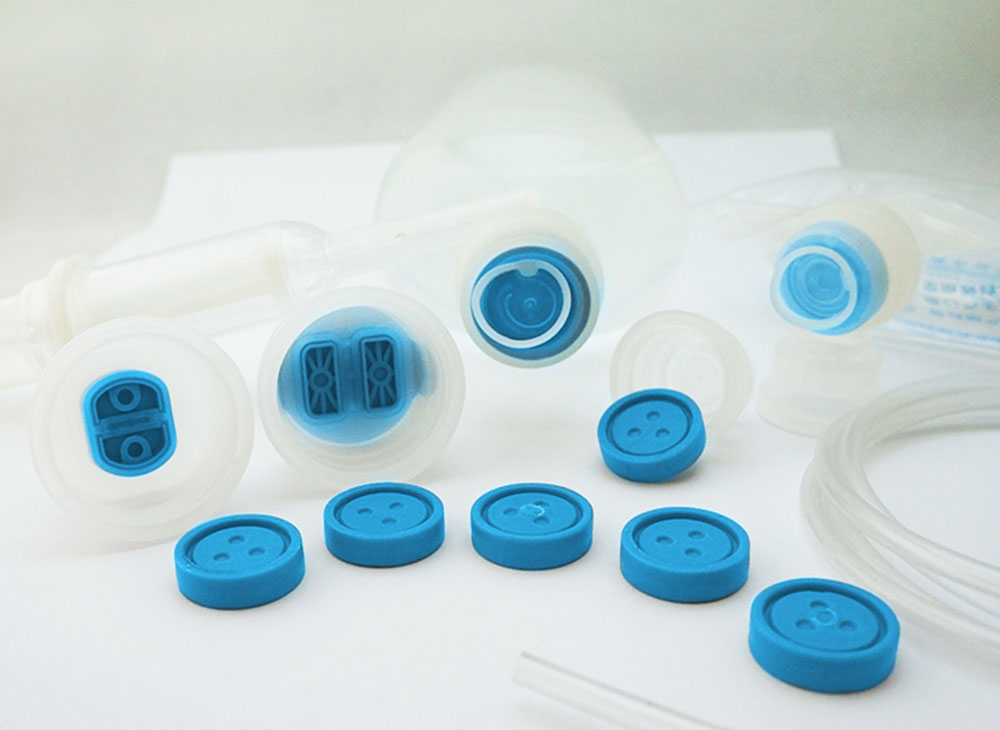
TM-45GWX is EVERLON's purpose-engineered TPE for pharmaceutical-grade IV bottle closures (Euro Caps). It delivers outstanding needle penetration performance, sealing integrity, self-sealing recovery, and coring resistance (per ASTM D395 testing standards), ensuring reliable closure performance under high-frequency automated needle penetration. The compound has been qualified and adopted by leading global pharmaceutical manufacturers.
In-House Application Testing & Compounding R&D
EVERLON's technical center is equipped with blow molding test equipment, cast film extrusion lines (for flexible film evaluation), and tube extrusion pilot systems. Our compounding team develops custom formulations tailored to your specific application requirements.
Application Case Studies: EVERLON Compounds in Action
The case studies below show how EVERLON has helped customers resolve critical material challenges in pharmaceutical IV closure applications. Contact EVERLON's technical team for a detailed discussion of your specific application.
| Eliminating Post-Puncture Leakage in IV Closures | Global Pharmaceutical Manufacturer |
|---|
|
Background & Challenge A global pharmaceutical manufacturer had long relied on conventional vulcanized rubber for Euro Cap IV bottle closures. As their production lines moved toward higher-speed automated needle penetration, two critical failure modes emerged: first, insufficient post-puncture elastic recovery led to a persistent micro-leakage rate that compromised sterile barrier integrity; second, residual low-molecular-weight extractables from the vulcanization process caused inconsistent results in USP Class VI biocompatibility testing, delaying new product submissions. |
|
EVERLON's Solution Following a detailed review of the customer's needle gauge specifications, puncture frequency, and sterilization protocol, EVERLON recommended TM-45GWX — a cleanroom-manufactured, SEBS-based compound that is inherently free of vulcanization residuals. EVERLON's application engineering team provided tailored processing parameters optimized for the customer's existing tooling geometry and injection press specifications. |
|
Outcomes Following qualification and production ramp-up, the customer achieved measurable improvements across three key metrics:
* This case study represents a generalized scenario based on typical application requirements. Actual performance data will vary by product specification and test conditions. Contact EVERLON for an application-specific evaluation. |
High-Performance Overmolding: Touch, Grip, and Vibration Damping
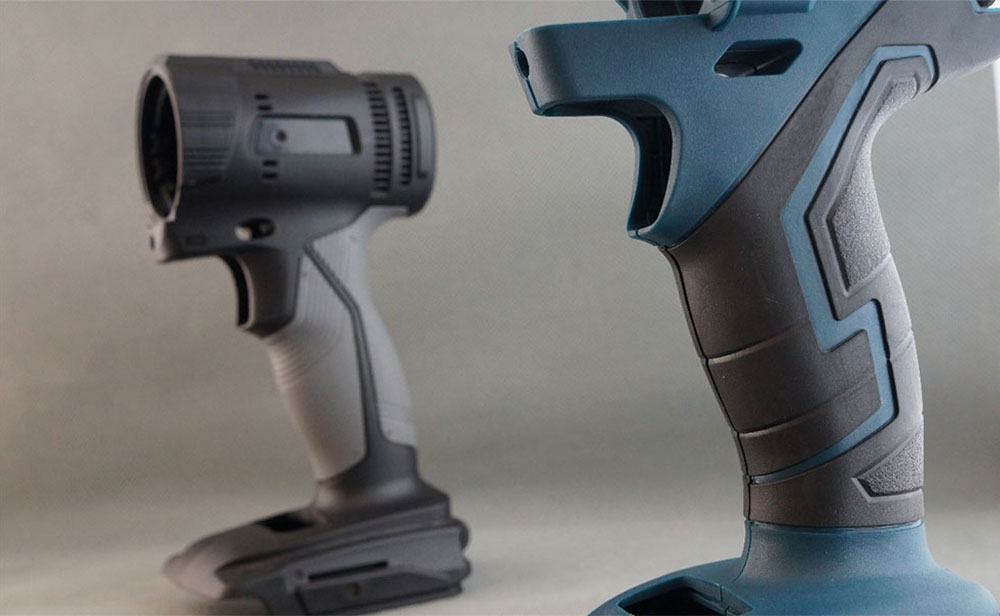
Leveraging its advanced compounding expertise and application engineering experience, EVERLON offers a line of specialty TPE overmolding compounds engineered to bond reliably to a wide range of substrates, delivering exceptional soft-touch feel and vibration damping that add significant product value. Three core advantages:
-
Broad substrate compatibility: bonds to PP, PE, PC, ABS, PET, PBT, PMMA, PA, HIPS, AS, POM, and TPU substrates.
-
International certification compliance: RoHS, REACH, and UL certified, supporting customers’ market access requirements.
-
Wide application range: suitable for consumer products, industrial tools, and medical applications requiring high-value overmolding solutions.
Through EVERLON’s specialized TPE formulations, manufacturers can create high-value-added products that balance sustainable recyclability with optimized performance.
| TAN-65B — Conquering the Toughest PA (Nylon + GF) Overmolding Challenge |
|---|
|
Background & Challenge During operation, power tools must withstand high impact forces, requiring PA+GF (Nylon + Glass Fiber) for structural integrity. At the same time, grip areas must deliver superior tactile comfort and vibration damping, achievable only through TPE overmolding. Conventional TPE compounds, however, present a significant bonding challenge when overmolded onto PA+GF substrates. A new TPE formulation had to be developed and optimized to deliver a reliable, high-value overmolding solution. |
|
EVERLON’s Solution EVERLON’s R&D team engineered a dedicated TPE overmolding compound specifically formulated for PA+GF substrates, achieving strong and durable adhesion that fully meets the customer’s design requirements. The solution also achieved UL certification and passed chemical resistance testing for power tool applications, including resistance to gasoline and other industrial chemicals. |
|
Outcomes Following introduction of TAN-65B high-performance TPE overmolding compound, the customer’s products achieved measurable improvements across multiple key metrics:
* This case study represents a generalized scenario. Actual certification timelines and requirements will vary by product specification and market. Contact EVERLON for application-specific guidance. |
Frequently Asked Questions (FAQ)
-
Is TPE better than TPR?
"Better" depends entirely on the application requirements. TPE (SEBS-based) outperforms TPR in UV resistance, weatherability, biocompatibility, and long-term dimensional stability — making it the preferred specification for medical, food-contact, and outdoor applications. TPR (SBS-based) has the advantage in surface friction, adhesive bonding compatibility, and raw material cost, making it better suited for indoor consumer goods and footwear. Neither is universally superior; the correct specification is determined by end-use environment, service life expectations, and applicable regulatory requirements.
-
Is TPR recyclable?
Yes. TPR and TPE are thermoplastic materials — they can be remelted and reprocessed, making them theoretically recyclable. This is a significant advantage over vulcanized rubber, which cannot be remelted. In practice, effective recycling requires material segregation at end-of-life, as commingling with dissimilar polymers degrades the mechanical properties of the recyclate. EVERLON recommends working with qualified recyclers familiar with SBC-based elastomers to ensure recyclate quality meets acceptable performance thresholds.
-
Can TPE replace rubber?
In the majority of applications, yes. TPE delivers rubber-like softness and elasticity while offering the processing advantages of thermoplastics: no vulcanization, full recyclability, and dramatically shorter cycle times. However, in applications requiring extreme continuous service temperatures (above 300°F / 150°C), exposure to aggressive solvents, or ultra-high tear strength, certain specialty rubbers — such as silicone or fluoroelastomers (FKM) — retain performance advantages that current TPE formulations cannot fully replicate. A detailed substitution analysis based on thermal, chemical, and mechanical requirements is recommended. EVERLON's technical team is available to support this evaluation.
-
Are TPE and TPR materials safe? Do they contain harmful substances?
TPE and TPR materials are inherently free of BPA, PVC, and phthalate plasticizers. When formulated and manufactured to medical- or food-grade standards — such as EVERLON's EVERMedi and EVERSeal product lines, which comply with FDA, USP Class VI, RoHS, and REACH — they are suitable for use in infant products, pet accessories, and direct-contact medical devices.
-
What are the sustainability advantages of TPE over conventional rubber?
TPE and TPR are 100% recyclable thermoplastics. Their processing eliminates the sulfur-based vulcanization step, reducing energy consumption per part and removing sulfur-containing cure system waste from the process. Cycle times are reduced from minutes (typical for vulcanized rubber molding) to seconds, further lowering per-unit energy intensity. These attributes support circular economy initiatives and are increasingly relevant to sustainability reporting frameworks such as Scope 3 emissions tracking.
Ready to specify the right material for your application?
Whether you need a soft-touch overmold compound, a high-performance under-hood seal, or a fully documented medical-grade formulation,
EVERLON's application engineering team is ready to support your material qualification process.
[ Contact EVERLON — Start Your Custom Compound Project Today ]